Be Aware of what your Children are Learning in School

2020 6 9

IMG_9859

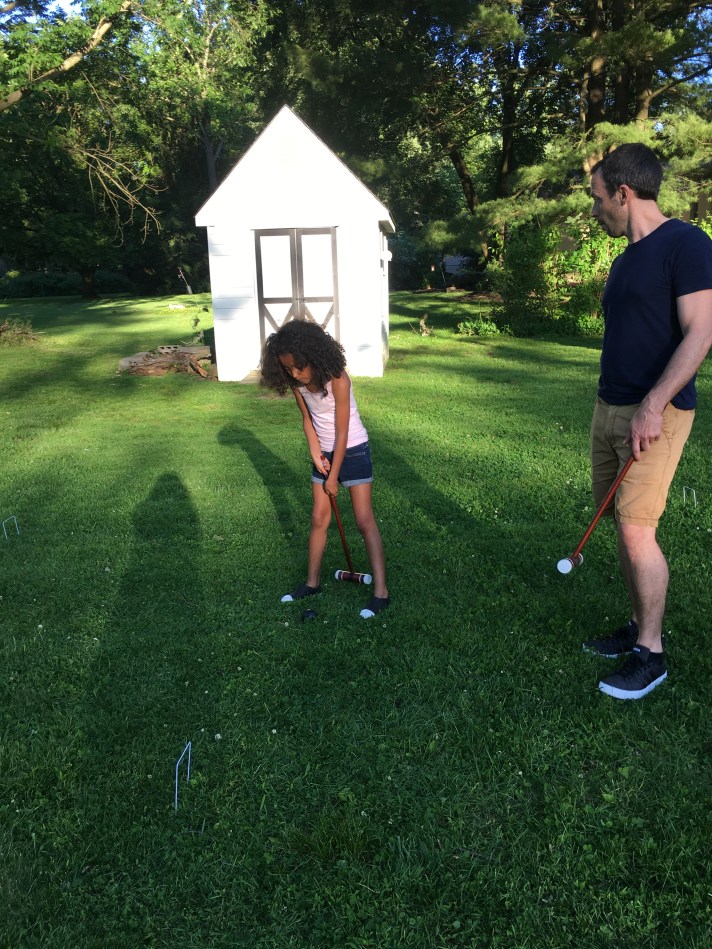
I remember summer evenings when I was young. We would swarm around the neighborhood at dusk, kicking the can, playing ball, or hiding like sardines. So when I invited my family over one summer evening to play, why were my granddaughters standing in a line, mallet at rest in front of them, patiently watching us take our turns at croquet?

My granddaughters are eight and six and just graduated from the local public school. My grandson is three and only managed a few months of preschool before COVID shut down that experience.

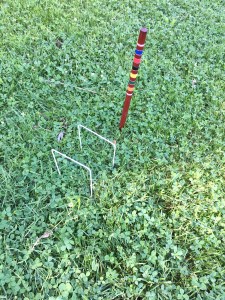
So, one lovely summer evening, I invited my family over to play croquet. The children were enchanted when handed their own colored mallet with a matching ball. I showed them two ways to hit the ball, and they needed no encouragement but immediately began banging away at the balls, moving slowly away from the house in a ragged little row. I called for help when I began pounding the poles and pushing the wickets into the ground. They were all eager to pound and push.

When ready, we took turns, playing oldest to youngest so they could see how the game was played. We hit our balls and progressed slowly around the course, my son in the lead, followed by me, then the girls. The three-year-old was having a jolly time, pushing his blue ball around the grass with his mallet, nudging it gently through some wickets. Occasionally he would lie down, put his head in the grass and gaze through a wicket.

After a while I realized that my granddaughters kept going back to the starting line and standing there, in a line. They’d hit the ball through a wicket and immediately head back to the starting wicket. If I reminded them that they get another turn because they went through a wicket, they’d bound back, wallop the ball, then gallop back to the starting line. So, eventually, I stopped and asked them why they were doing that, going back to where we started. And they didn’t have an answer. They just shrugged their shoulders.

Clearly, they learned this behavior in school. I had thought they’d be running madly around the yard and that we’d have to call them to come take their turns.

My grandson exhibited an entirely different learned behavior. He hadn’t really been to school. He too was acting in a way aligned with his background. However, I was unaware of his thinking/understanding until my son finally won the game. We all whooped a bit and jumped around in acknowledgement, when I noticed that the three-year-old was crying. I knelt down, he was lying near a wicket, and asked what was wrong. “I lost,” he sobbed. I hadn’t even realized that he thought he was playing the game. I assured him we’d play till everyone got to the end. Somehow that fixed it, he smiled and went back to pushing his ball around and looking through wickets. I knew he had already learned about winning and losing. He loved UNO, and when he lost he’d melt into a puddle on the floor with a few sobs, then hop to play again. When he won he’d jump up and down and pump his arm in the air. However, he had very little experience with organized games.

The girls had learned a lot more about games than he had. School had taught them about the rules of games and winning and losing. It also taught them procedures like standing quietly in line while waiting for your turn. I would never have guessed that that protocol would have translated to a summer evening croquet game in the backyard. I imagined they’d be running all over the place and we’d have to call them back for their turn.

Standing patiently in line behind the starting wickets was a STOP sign for me, a BEWARE sign. My point is not that standing patiently in line behind the starting wickets was a bad thing! Some people would view it as exactly what a child should be learning. Others would remember those warm summer nights traipsing freely around the neighborhoods in swarms of playmates and wish that for their own youngsters. Couldn’t children learn to stand patiently in lines just when needed like outside stores during a pandemic or during PE class when you have 25 kids in a class and a curriculum to execute?

My point is how unaware we are of what we are learning. The girls couldn’t explain to me why they were standing there. They just shrugged their shoulders and probably wondered why I cared. We are so molded by what happens to us, by our background and the content /context of our past lives. And we are so unaware how those events shape us.

My grandson had less experience with life, only three years. And there was something endearing about his behavior, his self-centeredness, his unawareness of others, mediating his life with this blue hard ball and something called a mallet you could hit the ball with. And these wickets, stuck in the ground…he was strong enough to push them in. I wonder what it looks like down there. He also knew a game was going on around him, enough to be crushed when his experience informed him that he lost. How can his approach to the world around him be nurtured and encouraged and not squashed or smashed?

A lot of schools’ lessons are how to do school: same age classrooms, lectures, standing in lines, testing, grading, labeling to name a few. Do they balance well against what a child might learn in a different setting?
IMG_9854


How Much Time for School?

WSJ Opinion. June 6, 2020.  Andy Kessler’s Give Online Learning an Upgrade

Video lectures leave students cold. Better to have personalized interactive courses.

 A lot of parents are figuring out that remote learning, forced on us by school closings, is mostly same old same old, teachers droning on to students, except online. Not much has changed in education since the Little Rascals’ Miss Crabtree’s one-room class in 1930.  And it’s broken. Even before COVID more than half of incoming students at community college required remedial math or English courses…something is seriously wrong.

 Kessler isn’t writing a research paper, his opinions aren’t cited, but they are very familiar ideas. He offers up ‘flipped classrooms’ as an attempted solution being used by some schools, but he really is showcasing Kahn Academy, and rightly so. Kahn Academy is a tool and a good one. It allows access to learning in a free and interactive way, where you don’t have to be dragged or drag yourself through information you already know, and if you are struggling you can easily access repeated instruction. Homeschoolers have been using Khan Academy for years, pretty much since it’s inception.  (2008 by Salman Khan)

For me the question remains just how bad are traditional schools?  Is it really same old same old? I know there have been advances and credit should be given. But in many respects, traditional schooling hasn’t really changed in substantive ways.

COVID-forced online learning has taught many I know that school often drags on and on…much time is wasted. Kessler argues that time should become the variable. I’m not exactly sure what he means, but I understand the wasted time. My eight-year-old granddaughter took a month to figure things out when her second-grade class went online. She went along with all the classes, lectures, practice etc.. that her teacher put out there.  She took the ‘breaks’ when suggested and finished up school after lunch, as I think her teacher intended. Till one day she got up early, started school, and finished all that was required of her in an hour. She surprised herself. But don’t think she went back to the earlier way, that took hours out of her day. She pretty much completes school in an hour or less every day now. The sad thing is that COVID keeps her from taking advantage of the world around her, the experts and opportunities that she could learn from if she were free to move around.


Food For Thought – Reflections on How to Deliver Understanding

2020 6 6

I recently listened to a Sam Harris podcast where he interviewed Daniel Markovitz about his book The Meritocracy Trap. Apparently Markovitz’s book includes suggested changes to our educational system where higher education expands and educates many more students at a cheaper rate per child.

My research, and any dependent expertise, is not about high education as much as younger learners. And, first point, education and learning are not always closely aligned. Just think of the vast amount of learning that occurs in a child’s life before they even enter school, and many people observe that school is often the great crusher of children’s curiosity and innate desire to learn.

Sam historically has made fundamental arguments about how we do not have free will because we are so much a result of our environment. Our choices are pretty much dictated by the life we have lived, the circumstances we have experienced, and if we could be given similar situations or choices a second time, we would most likely make the same choices. Therefore, I find it interesting that he posits the question to Daniel, “What if teachers were really valued, and there was great competition for the highly valued job of teaching and teachers would be paid really well? Then he guesses that education would be vastly improved. He suggests the highly paid job be a second-grade teacher, not just college professors.” But a child’s environment is so much more than the school they attend. Even with schools vastly increasing required attendance time, children still spend more time out of school than in, and this has to have a huge impact on their success in school or put in other terms, their ability to learn. The very affluent families Daniel refers to provide their children with a very different life outside of school than the much less affluent families. I don’t imply less love or good intention alongside less affluence, but less of a life that would lead to success in college or possibly a more affluent life-style than the one they are currently in. So does more money improve a child’s chances or are their future choices dictated more by their environment than their school.

Another point, one thing some parents have learned during this time of COVID-19 Pandemic schooling, is that it only takes a very short time to complete the amount of daily academic work a child is required to do each day in school. The rest of school time is spent on arrival, settling in, transition, social life, lecture or instruction they don’t need (assuming some they do), recess, lunch, and all the specials. (This is not a plea to take the arts out of school; if children are going to be required to spend the bulk of their day there, then the arts are very important.) School has become the babysitter and food provider that many families need and have come to rely on. Maybe schools should exist for this very reason. But for families who could provide a different environment, they should think about it.

I think the problem with our education system is rooted in our ideas of how children learn.

At one point in the podcast Daniel says, “We really haven’t figured out how to deliver understanding except through close intellectual engagement like we are having now (Daniel and Sam)…one conversation at a time…that’s the model and that’s what limits our ability to scale up education 100 times.”

I think he’s correct, we haven’t really figured out how to deliver understanding, especially in a classroom with many children. Some children are reached, but so many others aren’t, and criticisms abound as to why. In almost all elementary school classrooms you don’t have the opportunity for close intellectual engagement or ‘one conversation’ at a time.

Homeschooling, in the traditional sense, and not the COVID-19 sense, provides an environment much more conducive to one conversation at a time and closer intellectual engagement if only because there are far fewer learners, and a much better ratio of adult to child.

I want to argue too that parents should not fall back on “I’m not educated enough to homeschool my children.” A parent in my study told the following story of her coop having a book sale where they also held open meetings for families thinking about homeschooling or new homeschooling parents.

We had these chat rooms with a panel of five or six more experienced homeschooling moms. There were five or six moms standing all around the room, some holding babies. Each of the experienced moms introduce themselves, and then they ask if anyone has any questions about the different curriculums we use and our different circumstances. And so, one of the moms said well you all seem so well educated. And we all looked at each other and just laughed. Because some of us knew each other. I mean I have some college, but I don’t have any teaching degrees, or I don’t have any degrees. All of our education has come from homeschooling. I took the last twenty years explaining history and archeology and learning along with our kids, and as long as we’re one day ahead, we’re still one day ahead. And then when we don’t know and we can’t catch up and they go right past us, we find somebody else to teach them.

When I homeshooled my children is when I learned grammar. Look at it as an opportunity to learn alongside of your youngster.