
2020 6 9
I remember summer evenings when I was young. We would swarm around the neighborhood at dusk, kicking the can, playing ball, or hiding like sardines. So when I invited my family over one summer evening to play, why were my granddaughters standing in a line, mallet at rest in front of them, patiently watching us take our turns at croquet?
My granddaughters are eight and six and just graduated from the local public school. My grandson is three and only managed a few months of preschool before COVID shut down that experience.
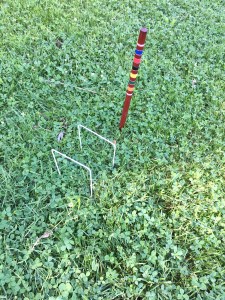
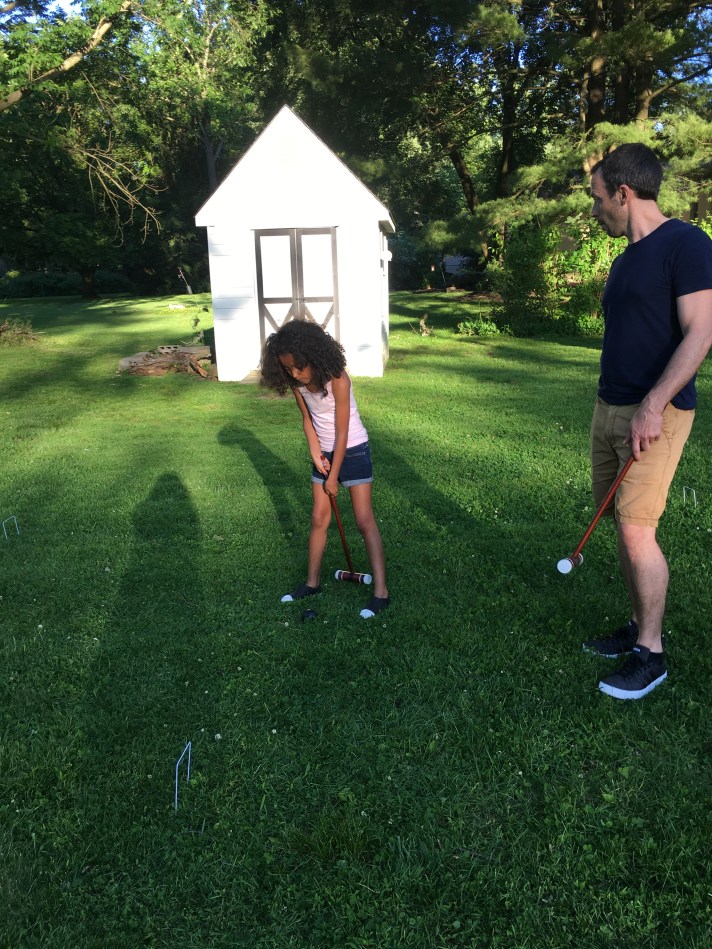
So, one lovely summer evening, I invited my family over to play croquet. The children were enchanted when handed their own colored mallet with a matching ball. I showed them two ways to hit the ball, and they needed no encouragement but immediately began banging away at the balls, moving slowly away from the house in a ragged little row. I called for help when I began pounding the poles and pushing the wickets into the ground. They were all eager to pound and push.
When ready, we took turns, playing oldest to youngest so they could see how the game was played. We hit our balls and progressed slowly around the course, my son in the lead, followed by me, then the girls. The three-year-old was having a jolly time, pushing his blue ball around the grass with his mallet, nudging it gently through some wickets. Occasionally he would lie down, put his head in the grass and gaze through a wicket.
After a while I realized that my granddaughters kept going back to the starting line and standing there, in a line. They’d hit the ball through a wicket and immediately head back to the starting wicket. If I reminded them that they get another turn because they went through a wicket, they’d bound back, wallop the ball, then gallop back to the starting line. So, eventually, I stopped and asked them why they were doing that, going back to where we started. And they didn’t have an answer. They just shrugged their shoulders.
Clearly, they learned this behavior in school. I had thought they’d be running madly around the yard and that we’d have to call them to come take their turns.
My grandson exhibited an entirely different learned behavior. He hadn’t really been to school. He too was acting in a way aligned with his background. However, I was unaware of his thinking/understanding until my son finally won the game. We all whooped a bit and jumped around in acknowledgement, when I noticed that the three-year-old was crying. I knelt down, he was lying near a wicket, and asked what was wrong. “I lost,” he sobbed. I hadn’t even realized that he thought he was playing the game. I assured him we’d play till everyone got to the end. Somehow that fixed it, he smiled and went back to pushing his ball around and looking through wickets. I knew he had already learned about winning and losing. He loved UNO, and when he lost he’d melt into a puddle on the floor with a few sobs, then hop to play again. When he won he’d jump up and down and pump his arm in the air. However, he had very little experience with organized games.
The girls had learned a lot more about games than he had. School had taught them about the rules of games and winning and losing. It also taught them procedures like standing quietly in line while waiting for your turn. I would never have guessed that that protocol would have translated to a summer evening croquet game in the backyard. I imagined they’d be running all over the place and we’d have to call them back for their turn.
Standing patiently in line behind the starting wickets was a STOP sign for me, a BEWARE sign. My point is not that standing patiently in line behind the starting wickets was a bad thing! Some people would view it as exactly what a child should be learning. Others would remember those warm summer nights traipsing freely around the neighborhoods in swarms of playmates and wish that for their own youngsters. Couldn’t children learn to stand patiently in lines just when needed like outside stores during a pandemic or during PE class when you have 25 kids in a class and a curriculum to execute?
My point is how unaware we are of what we are learning. The girls couldn’t explain to me why they were standing there. They just shrugged their shoulders and probably wondered why I cared. We are so molded by what happens to us, by our background and the content /context of our past lives. And we are so unaware how those events shape us.
My grandson had less experience with life, only three years. And there was something endearing about his behavior, his self-centeredness, his unawareness of others, mediating his life with this blue hard ball and something called a mallet you could hit the ball with. And these wickets, stuck in the ground…he was strong enough to push them in. I wonder what it looks like down there. He also knew a game was going on around him, enough to be crushed when his experience informed him that he lost. How can his approach to the world around him be nurtured and encouraged and not squashed or smashed?
A lot of schools’ lessons are how to do school: same age classrooms, lectures, standing in lines, testing, grading, labeling to name a few. Do they balance well against what a child might learn in a different setting?

 Off the Beaten Track