Be Aware of what your Children are Learning in School

2020 6 9

IMG_9859

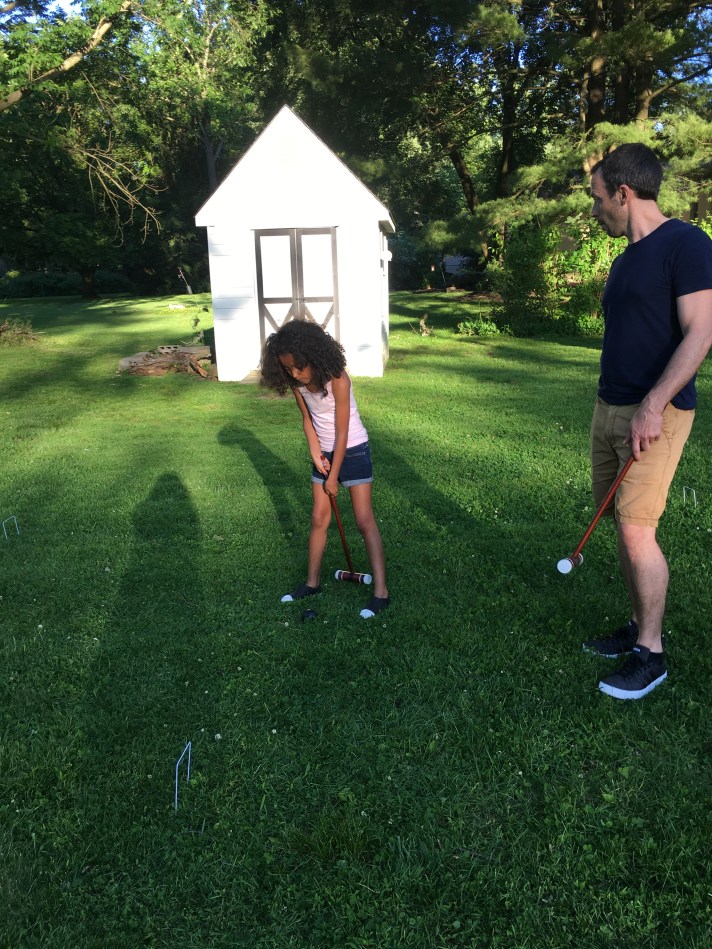
I remember summer evenings when I was young. We would swarm around the neighborhood at dusk, kicking the can, playing ball, or hiding like sardines. So when I invited my family over one summer evening to play, why were my granddaughters standing in a line, mallet at rest in front of them, patiently watching us take our turns at croquet?

My granddaughters are eight and six and just graduated from the local public school. My grandson is three and only managed a few months of preschool before COVID shut down that experience.

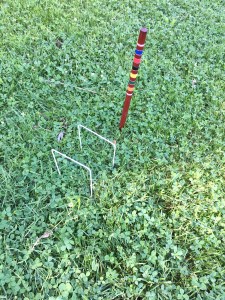
So, one lovely summer evening, I invited my family over to play croquet. The children were enchanted when handed their own colored mallet with a matching ball. I showed them two ways to hit the ball, and they needed no encouragement but immediately began banging away at the balls, moving slowly away from the house in a ragged little row. I called for help when I began pounding the poles and pushing the wickets into the ground. They were all eager to pound and push.

When ready, we took turns, playing oldest to youngest so they could see how the game was played. We hit our balls and progressed slowly around the course, my son in the lead, followed by me, then the girls. The three-year-old was having a jolly time, pushing his blue ball around the grass with his mallet, nudging it gently through some wickets. Occasionally he would lie down, put his head in the grass and gaze through a wicket.

After a while I realized that my granddaughters kept going back to the starting line and standing there, in a line. They’d hit the ball through a wicket and immediately head back to the starting wicket. If I reminded them that they get another turn because they went through a wicket, they’d bound back, wallop the ball, then gallop back to the starting line. So, eventually, I stopped and asked them why they were doing that, going back to where we started. And they didn’t have an answer. They just shrugged their shoulders.

Clearly, they learned this behavior in school. I had thought they’d be running madly around the yard and that we’d have to call them to come take their turns.

My grandson exhibited an entirely different learned behavior. He hadn’t really been to school. He too was acting in a way aligned with his background. However, I was unaware of his thinking/understanding until my son finally won the game. We all whooped a bit and jumped around in acknowledgement, when I noticed that the three-year-old was crying. I knelt down, he was lying near a wicket, and asked what was wrong. “I lost,” he sobbed. I hadn’t even realized that he thought he was playing the game. I assured him we’d play till everyone got to the end. Somehow that fixed it, he smiled and went back to pushing his ball around and looking through wickets. I knew he had already learned about winning and losing. He loved UNO, and when he lost he’d melt into a puddle on the floor with a few sobs, then hop to play again. When he won he’d jump up and down and pump his arm in the air. However, he had very little experience with organized games.

The girls had learned a lot more about games than he had. School had taught them about the rules of games and winning and losing. It also taught them procedures like standing quietly in line while waiting for your turn. I would never have guessed that that protocol would have translated to a summer evening croquet game in the backyard. I imagined they’d be running all over the place and we’d have to call them back for their turn.

Standing patiently in line behind the starting wickets was a STOP sign for me, a BEWARE sign. My point is not that standing patiently in line behind the starting wickets was a bad thing! Some people would view it as exactly what a child should be learning. Others would remember those warm summer nights traipsing freely around the neighborhoods in swarms of playmates and wish that for their own youngsters. Couldn’t children learn to stand patiently in lines just when needed like outside stores during a pandemic or during PE class when you have 25 kids in a class and a curriculum to execute?

My point is how unaware we are of what we are learning. The girls couldn’t explain to me why they were standing there. They just shrugged their shoulders and probably wondered why I cared. We are so molded by what happens to us, by our background and the content /context of our past lives. And we are so unaware how those events shape us.

My grandson had less experience with life, only three years. And there was something endearing about his behavior, his self-centeredness, his unawareness of others, mediating his life with this blue hard ball and something called a mallet you could hit the ball with. And these wickets, stuck in the ground…he was strong enough to push them in. I wonder what it looks like down there. He also knew a game was going on around him, enough to be crushed when his experience informed him that he lost. How can his approach to the world around him be nurtured and encouraged and not squashed or smashed?

A lot of schools’ lessons are how to do school: same age classrooms, lectures, standing in lines, testing, grading, labeling to name a few. Do they balance well against what a child might learn in a different setting?
IMG_9854


How Mollie uses a Bought Curriculum

Mollie began homeschooling her oldest child using online Cyber school and then a Calvert Curriculum that was quite comprehensive. But eventually she chose Tapestry of Grace, a Christian curriculum that covers reading and writing and history, but not math and science. It is organized into a classical four-year cycle with grammar, dialectic, and rhetoric.

Tapestry of Grace can be purchased with “everything in a box,” including teachers’ manuals, overviews, goals, assessments, and all the books and materials you would need. But there is a less expensive way where you buy just folders that have guidelines for everything, guidelines of what you need, when to teach and ways to teach it, teacher’s notes and worksheets. You can either order books from Tapestry of Faith or find them in the library or book stores. It comes with a computer disk that has all of the worksheets that you can print out and it connects to a website where you can update your booklist.

Tapestry Grace includes grade levels K-12. It’s organized in four-year sections recycling three times. Notebooks for each subject include all grades, so you can do say Pride and Prejudice with Mason, and something else with Gracie in the same time period and there’s a little book for Gwenny and they’re all together in the same place doing the same time period.

Even though Mollie used Tapestry of Faith throughout most of their years of homeschooling, she found many other sources to augment and improve their program. Unhappy with the writing part of Tapestry of Faith Mollie found the Institute for Excellent Writing (IEW). This was a highly structured writing program that intrigued Mollie and worked for at least Mason and Gracie. Mollie tells how Gracie was doing all her writing online and masking the fact that she was using all the wrong words at all the wrong times and wasn’t spelling anything correctly because she used a program with autocorrect. So, she put Gracie back on a regular spelling workbook program. With some other homeschooling families, a literature discussion group was cobbled together for Gracie and some friends. Gracie and her friends took turns organizing lessons and taking on a leadership role for the group and eventually the group added a historical element to the activity. Another very popular writing device for Gracie was NANOWRIMO (National Novel Writing Month), an online site where one sets a writing goal for the month of November. The process often included setting up word counts per day with the ultimate goal being to complete a novel in a month. The social interaction with other girls really drew Gracie in, as it has other girls in my study, and the writing usually lasted throughout the school year.

Some other learning opportunities Mollie used were Duolingo, a language website where her kids learned different languages. She found a four-year program of great philosophers: Abraham, Confucius, Socrates, Plato etc. They read their works and had discussions with these philosophers. And when her oldest approached higher education, Mollie as well as Mason learned the ropes of online courses, both synchronous and asynchronous.

In a culture where we have come to rely on schools to educate our children, it is comforting to wake up each morning, assemble your children around the kitchen table, pull out a sheaf of papers that represent a well-researched, organized approach to teaching children much like the traditional schools use, and begin teaching.  And as we see with Mollie, a homeschooling mom, dealing with only a handful of children, it’s hard not to change things around to fit better.


Child-led versus Parent-led Learning

Elsa and Renee are two parents who use no curriculum at all and both of them have always homeschooled their girls. Their backgrounds and educational credentials differ, as do the lenses through which they view learning. But they both have chosen a learning style without a structured curriculum.

Elsa’s girls have attended a number of classes like theatre and homeschooling co-ops, but they have had no curriculum to speak of, not even textbooks. Elsa’s philosophy of learning for her girls pretty much explains why there is no curriculum.

I’ve become even more comfortable and trusting in the process of them exploring what is meaningful and interesting to them. At this time of year, when kiddos are going off to school, I’m really happy that Annette and Caden have the opportunity to have more of a free childhood and life to develop their potential because they’re not having to do things that are being set for them to do, that they don’t have any interest in.

This family provides a view of a context where the learning is almost entirely child-led.

 Renee is a teacher. She has a carefully thought-out approach to learning that appears to discredit ‘learning from a book’; even more, learning from a highly structure curriculum that describes how and what to learn. She wants her girls to immerse themselves in their world and figure things out within that context.

When we’re walking down the street and I see a word on a van, I say Let’s try to figure out this word. It’s right there. I want them to realize that you can learn anywhere, you can learn while you’re sitting in the backseat of the car, whether you look at billboards or license plates. You can be at home and find anything on the dining room table and learn about it. My philosophy is I want my kids to not just open up this one book to page 17 and be able to read it and answer the question…I want them to look at someone’s shirt and know that man traveled to Hawaii based on what was on his shirt.

Anything in their life becomes their “curriculum.” Renee’s kids have done post card exchanges. She encourages her children to read newspapers. They have learned about writing letters to the editor of newspapers and even composed a few. They also take field trips to the local theatre, shows and dance. The dance company provides packets of information and Renee might use that as a word search for her younger children or have her older girls write up a summary. She may provide an interesting picture and have them write a story about it. Their family writes collaborative stories. Renee plays a crucial role in structuring the learning environment for her children.

While both families avoid curriculums, their approaches differ, Elsa’s being child-led learning and Renee’s being parent-led learning. I’m interested in examining the progress of Elsa’s children, leading their own search for knowledge. Infants and toddlers are so successful at learning, and they are primarily self-led. At some point parents and teachers take over and guide them along. As a culture we have come to rely on that approach, the well-established trail that educators have created. I am also interested how Renee’s children’s progress, with Renee doing much more of the guiding, but along such a different track than traditional schools.


What can a Successful Curriculum Look Like?

As I finish up my first round of analyzing the data from five years of research I am profoundly struck by how different each homeschooling story is. For those novices to homeschooling, I beg you not to think you know what is going on when you hear someone say homeschooling. These stories I present about how curriculum is or isn’t used in these fourteen homeschools have required me to describe something entirely different every time!

—————————————–

I sat down today to report on Elizabeth’s data, thinking here’s a family who used lots of curriculum. I realize I am right, they did, but oh my goodness, Elizabeth never bought any curriculum, the ones her girls used were all different and often child-managed. Elizabeth was a parent who delighted in homeschooling and came up with lots of non-curriculum fun ideas helping her daughters select books, engaging in literary discussions, organizing writing projects and they would have regular tea parties where they shared poetry they loved.

Adjusting the learning environment to meet children’s needs is much easier when homeschooling, and Elizabeth took great advantage of this benefit. Her youngest daughter, Ella, loved the outdoors, nature and animals. Ella put a tent in the backyard and slept in it for almost a full year, including the winter,

She slept outside. Periodically she will do about a four- or five-day stint where she doesn’t eat anything except for what she can forage for or catch herself. So, she knows what bark you can eat, what leaves you can eat. She knows what kind of weed makes a seed which she found in our yard and she mashed it up and fried it and it turned into a salt substitute, and then this other plant she got that you can make a paste with for pancakes. So, she made pancakes with stuff she found. She fried up earth worms and ate them one day. I mean this is her. 

Ella also loves animals. She earned money babysitting, so she could buy and fill three huge fish tanks. She also has a ball python, a bearded dragon, two fire-bellied toads, and a rabbit. My mother got her a turtle. Ella was very upset because the turtle’s tank was too small, so she nagged my mother until she got her a bigger tank from Craig’s list.

———————————————–

The question remains, is following a curriculum necessary for success in school? Elizabeth’s girls are older. My dissertation, the first year of this study, had focused on Ella, her youngest daughter, but all her girls had all been homeschooled and throughout these five years the older girls provide early measures of ‘success’, particularly using a more traditional heuristic*.

Bethany, the oldest, homeschooled from 3rd to 8th grade. She attended a local private high school and then received a Psychology degree from a local college with a merit scholarship. She works at a day care and is considering graduate school or a fuller job at the daycare.

Patrice, the next oldest, homeschooled for 2nd through 12th grade. She worked her way through high school, pretty much self-managing her own learning, using the same textbooks the local school was using. She received a full scholarship to Jacob’s School of Music in Indiana, and now is attending graduate school in music with a full scholarship plus stipend for living expenses at Notre Dame.

Kendra was homeschooled 3rd through 8th, skipped 9th grade and attended 10th – 12th grades at the local private high school. She attended the local college with a merit scholarship for two years and has transferred to Temple University.

Ella has homeschooled from 3rd through 10th grade.  She did try the first semester of her freshman year at high school, and that didn’t work out well, so she returned home to finish out the year,

Ella has been very much on her own this year. I would say she’s unschooling except that she is doing work that I think she feels I’m requiring her to do, so maybe that wouldn’t be called unschooling, technically, because she’s not just doing whatever she wants. But she’s largely doing whatever she wants with the pressure with knowing that we have to see an evaluator, so she better have something.

Ella is very into her music. Mostly she does research. She researches various pieces of music, of classical music, and she also does a lot of composing. She’s participating in Bryn Athyn Orchestra, Bucks County Youth Orchestra, the Philadelphia Youth Orchestra, an ensemble group and her cello lessons. So, she has all these five things that she goes to rehearsals for every week and does performances for. Ella has been searching for music colleges since she was in eighth grade. College is a goal for Ella, one she will undoubtedly meet.

The success of this family is obvious, at least measured by traditional educational standards. Many parents, including Elizabeth, have detailed different ideas about what is success. In many cases what is standard in traditional schooling is what nudged these families towards homeschooling, so it isn’t surprising that they might hold different ideas of what a successful outcome is. I will address these different heuristics in a separate post.

Photo by Lê Tân on Unsplash

Creative Curriculum

Susan was driven to make learning interesting and sometimes strayed from the traditional path. She started homeschooling because her oldest was bored in school. He was bright and quickly finished up assignments and sat around waiting for more. Susan knew she could offer him more at home.

I used a math textbook when I homeschooled my kids, and I found a workbook with science experiments. But I always was looking for creative ways to jazz up learning. Susan seems like a woman after my own heart, but she may easily top my creative efforts. Once, I decided we were going to only study pirates for a week! And that’s what we did. It was amazing. We read Howard Pyle’s Book of Pirates and visited the museum that displays the originals he painted for his book. We studied the Caribbean and the history of pirates. I’m sure we must have calculated the value of plunder on Black Beard’s ship and other such mind-bending activities. However, Susan picked a topic each month, for practically all the years she has homeschooled, and molded their studies around it. They studied the moon landing, the Erie Canal, Native American mythology, the Great Lakes, Aesop’s Fables, Seven Wonders of the Ancient World, physics and many other topics. Some favorite activities included Performance of the Week, where they studied a different genre of music each month and look at an example each week, electronics using Snap Circuits, mapping the journey described in Around the World in 80 Days, something with the Olympics every time they’re on, and a study of the states like when they were founded, their motto, and state birds, etc.

Susan thought a blog might be an opportunity for Ozzie to write creatively. Ozzie was all over the idea, “What would it be about? Oh Minecraft!!” Susan may suggest that today might be a write a post on your blog day,  but she doesn’t tell him what to write. She doesn’t proof read anything before he posts it. They talk a little about it, but it’s his thing. However, she likes to keep an eye on this activity because once Ozzie’s on the computer, he slips easily into watching YouTube videos of kids playing Minecraft instead of blogging about Minecraft.

In 2014 they used the book Hello World to learn Python. Susan thinks it’s important for her kids to learn computer programming,

I want them to be able to program. I think that’s important, to understand the basis of the Internet…I’d love for them to be able to make an app.

Last year Ozzie used Python to analyze wave data from the Great Lakes. Monitoring stations in the Great Lakes gather data. Ozzie learned to pull that data from buoys, organize the data, graph the data, even graph multiple lakes onto the same graph. But her daughter, Melanie, wasn’t nearly as interested in programming, so Susan took a different approach with her,

Melanie is not quite as interested in coding. I’m still looking for the right hook for her. This year we ended up reading a book called Computational Fairytales, which introduces coding concepts in a general, fairytale type story, which was the right way to do it for her.

While Susan is a teacher, she doesn’t write or use lesson plans. Each Sunday she plans out the week, writing out a schedule on paper and giving each child a daily list. Like many other parents, as her oldest approached high school, she began to feel nervous about their past endeavors,

Oh, I can’t put it into words…you know, a little bit of this, a little bit of that, some of this and some of that and we’d have big gaping holes, and I’d be like, “Oh, why didn’t I cover that?

She embedded some structured learning into their projects. Early on she used a book teaching writing called Rip the Page. Next, she tried a writing curriculum called Think Write that introduced the essay. And finally, as her fears rattled her nerves more regularly, she purchased a classical curriculum called The Well-Trained Mind that takes a more systematic approach to history and the classics. It encompasses logic and Latin and rhetoric.

We all worry about our children’s success. No matter how much we love homeschooling, and how excited we are watching our children learn, higher education casts a deep shadow over our joy. A belief that a standardized curriculum will best serve students in treading the path of learning often calms one’s nerves. It takes courage to wander off the path.

Photo by Louisa C. on Unsplash

Amy’s Curriculum – Living on a Goat Farm

Amy’s family lives on a goat farm. Schooling at home gives the children the opportunity to build feed racks, things for the garden, and various pens and gates. They help take care of the animals, Liam has raised turkeys and Noah has helped with selling livestock. They have even made soap. These experiences aren’t found in a traditional curriculum. Amy has a very pragmatic approach to schooling and is very adept at taking from school and from homeschooling what works best for her family.

I asked why Amy homeschools when she also sends her children to local schools, and she replied, “Quality I guess would be my biggest thing.” She explained, “that at home they have access to better materials and also get to be involved in things that they actually would want to do.” In school, there is so much dead time for them while they wait for other people to learn things. When a class full of children have to complete the requisite curriculum, everyone assimilates skills and knowledge at different rates, and when everyone must absorb everything, many children will have to wait around.

Amy is not an unschooler and neither does she buy curricula, “No, we’re definitely not unschooling. We do use, we don’t buy a curriculum.” But she uses many books, workbooks, and textbooks as well as live classes and online classes for her kids. She pays for some but finds many offered for free. For example, she borrowed and used books from the school district the first two years she homeschooled. She uses them as a jumping off point,

We did complete them but…let’s say if you’re reading about history and there’s this particular figure in history, maybe you want to read a biography about that person.

 Amy keeps a pretty tight rein on their learning but is also flexible.

For the little guys I obviously just pick their materials…They have a spelling book that I choose. They have a math book that I choose. If they do like an online game for learning I would choose that…But if they have a particular interest, for instance I require them all to play piano, but beyond piano, if they want to play another instrument, Caden chose violin… If one of the little ones shows a particular aptitude for something, I definitely would encourage it. Eli’s got a turkey project right now. He’s raising turkeys. That’s his project.

Also, when you’re learning at home it’s easier to move at your own pace and according to your own needs. One child learned math on her own using Khan Academy, and only searched out Amy if she needed help.

To augment their writing curriculum Amy encouraged them to participate in a contest held at a local library. You write a story and enter it and the winner’s story is turned into a book, entered into the card catalog, and the author gets a certificate and lots of attention.

We like our contests. Over the years contests have served us well… I always did those book contests because I wanted the kids to think of themselves as writers. And if they did a book contest and their book was hardbound in the library in the card catalog and they had a little certificate and they went to an awards ceremony, it was official, they were good at writing! … I just loved that opportunity for them to really think of themselves as being good at writing.

Emma, Noah, and Caden all wrote stories or poems and won this contest. Noah wrote a book about programming Python for sixth graders as well as a book on the history of Linux and the Linux operating system, “how to run Linux on your laptop and run your other operating system at the same time” (I’m sure you all understand this as well as I do. We should read his book). The library created a non-fiction category for the contest and Noah won first place two years running.

 As Amy’s children grow older and approach college, heading them in the right direction is most important.

We have to cover all the subjects. Then if they have an intense interest in a particular area…we follow that. As they mature the key is to figure out what they are really into and what they are good at and find them opportunities in that area.

One year, Noah built a desktop and worked on other laptops,

 I take the older computers add a Windows 2005, that’s the first edition that had WIFI, and all you have to do is install a Linux operating system onto it. I think I have two or three laptops now that I’ve converted to run Linux.

He worked at a grist mill which helped him pay for the parts for the computers and ran the online accounting aspect of their family goat business. None of this was part of a regular curriculum.

Photo by L ley on Unsplash

Kimberly: I Love Creating my Own Curriculum

Many of my parents love homeschooling. However, Kimberly exhibits a tremendous love of curricular content. She displays a deep interest in exactly what and how their curriculum should be built and seems to find joy doing it. She continually works at refining strategies for how certain subjects should be taught and why. For example, she has ideas about teaching cursive, and spelling;

I have discovered that it is important to teach cursive, so children can read it. Once my children were proficient at reading cursive, I stopped requiring them to write it, so they forgotten most of it now.

Even though spell check is available to them, I don’t think this can “teach” spelling nor be used as an excuse not to learn to spell. I still think spelling is an important subject to learn, so we do a traditional spelling program.

 Kimberly uses some technology in her planning and she struggles with how much “teaching of technology” she should do with her kids;

 When I’m researching a new subject to teach, primarily history/science, I use Internet searches extensively to plan the curriculum I will teach. For these subjects, I use a combination of traditional textbooks, regular ‘reading’ books, worksheets printed off the Internet, videos, field trips, etc.

 If that’s where technology is headed, you don’t type like this and you text like this (demonstrates texting in the air). So, is it worth teaching something that is probably going to be an outdated skill? And so, I struggle with this, and I have run out of time. If I had excess time it would probably get taught. I don’t have excess time, I’m cutting things out that I really want to teach, so I have a feeling that typing is going to end up not being taught.

Kimberly believes reading is “number one the most important thing of any skill that if I could only teach one thing ever, I’d teach reading, and I honestly think that they would end up being fine, because once you read, you can do anything.” Writing is the second most important thing to teach. Kimberly has worked very hard at writing with her children. She didn’t know how to teach writing, especially to children who didn’t want to write. I experienced this same challenge when I tried to teach writing to fourth graders who really didn’t have anything to say. She attempted to teach it and sometimes just gave up on it for a time, while her children developed other skills, and went back to it later, a strategy more easy for homeschooling moms to use that classroom teachers would find more difficult.

Kimberly talks a lot about loving the work she does to prepare for homeschooling. She has used a formal math curriculum for years and a spelling curriculum that she plans to continue using, and explains how she approaches building her own;

I usually take bits and pieces of a lot of things. I love creating my own curriculums. I find something that I could base it on. I spend a lot of time…I like my spelling program, it works, so I stick with that, but I think that in literature and vocabulary, I love being able to tie things in together. That’s one of the things I love most about homeschooling…we tied science and literature and history and all of those things in together. And there isn’t a curriculum I found that does it in a way I like, so I just make up my own. 

 Photo by LinkedIn Sales Navigator on Unsplash

An Unschooling Curriculum?

When Sara’s phone rang, she was surprised to see it was Ryan. He was at the local community college taking his first math test of the semester. What was he doing calling her? “Mom, I don’t know what’s going on in this test,” Ryan whispers, “I don’t know anything.” Sara explains further,

 He was almost in tears. Where are you? she asked. I’m in the bathroom. For whatever reasons the teacher let him get up in the middle of the test to go to the bathroom, which was kind of surprising to Sara. He was in a complete panic, because he didn’t recognize almost anything on the test.  

 Sara was thinking that she should have coached him better. She should have prepared him for a ‘test’. His experience learning at home included no test-taking and very little formal math instruction. So, she just gave him the best advice she could think of,

So, Sweetie, just take a breath, do what you can. Do not get caught up on any problem you don’t know, just go on to the next one.  Just let go of this one. This is going to be a bad test, that’s fine. Yeah, you can fail or whatever.

So, Ryan gets the test back, his grade is 30. He went and asked the teacher if he could take a retest or do extra credit. Sara said, “To his teacher’s credit I like that he said, ‘No, actually, I’m not going to coddle students. If you bomb something, learn something from it.’”

To some, this approach to learning math might seem faulty or inadequate. However, this was exactly the plan Ryan’s mother had for him. Ryan and his siblings were not just homeschooled, they were unschooled. Sara, believed all along that when Ryan needed to learn math, that would be the best time for him to study math. He would then use it for something that mattered to him.  After badly flunking his first test, he moved on, taking the accounting test and getting an 82, but because so many people did badly, the teacher rounded up, and Ryan ended up with a 92. And then on the probability test he got a 90, and finally on the statistics test he got 102. And this is a kid who literally had almost no math background.

Unschooling philosophy discards the whole idea of curriculum. Sara believes that kids are wired to learn what they need to know when they need to know it. Therefore, no set of skills or knowledge is predetermined for unschoolers. A traditional curriculum sets forth exactly what needs to be learned and when a child should learn it. In a school setting one might argue that the knowledge and skills sets defined in a curriculum are necessary for a child to learn because they are needed to accomplish the next step in the curriculum, not because the children need to use them in their lives.

Ryan has been unschooled from second grade through twelfth. But he has set his sights on college. As Sara contemplates the collegiate journey for Ryan she admits that he has, “holes in his learning.” It is an interesting term. There is no way anyone knows everything there is to know. There are always holes in one’s learning. But the term holds meaning for many because they are referring to the learning described by a standardized curriculum and an unschooler who isn’t following any curriculum will most likely have those kinds of holes in their learning.

Photo by Antoine Dautry on Unsplash

Roxanne’s Curriculum – Unschooling Extremely

Roxanne identifies their schooling as extreme unschooling.

 Yeah, what else can I tell ya? We unschool – extremely…I don’t plan things for them to do or try to push them too hard in any direction.

Unschooling, by most definitions, would not include a structured curriculum, or even an unstructured one. Roxanne’s strategy of not planning things for her boys or even pushing them towards something she thinks is important reflects an unschooling philosophy. She’s not building a curriculum of things that are important to her and adjusting it for her children’s interests like many other homeschoolers.

Roxanne has both shared her distrust of the educational authorities in Harrisburg and she has explained why she and her boys believe that most textbooks are outdated before they are even published. Roxanne reports Luke saying,

People who are often writing textbooks don’t know the subject they are writing about. They are basically anybody with a college degree, gets hired on a temporary basis to put this stuff together, they may or may not have any clue about the subject, and that’s how textbooks get so stupid. The thing too though, is he also knows that anything that has been printed out is already old news…If you’ve had time to make a textbook on it, it’s too late man, unless it’s on Ancient Rome.

Such beliefs could fuel an approach to learning that discards both textbooks and learning strategies such as Common Core. Therefore, the carefully arranged and balanced curricula used by schools would find no place in an unschooling home. Roxanne’s home is like that. Below she describes different ways that her boys learn.

First of all, when John comes home for dinner the question “What did you learn at school today?” is never asked. Instead Roxanne reports far-ranging conversations that astonish her. She is usually surprised at the things her sons are interested in and have learned.

There’s constant conversation instigated by the kids about everything from world politics, the history of Rome, the Mormon faith. I mean they stun me with the vast amounts of things that interest them and how they pick it up and remember huge amounts of information and can verbally dance circles around anybody.

She explains how their learning is like following threads of information. She tells a story about how Luke learns about foxes,

They’ll read a story about foxes. Luke will start looking into more about foxes, more about domesticating foxes, how they domesticate foxes, why they domesticate foxes, what are the problems with it, what could be the benefits. Then that might make him look up another animal that was bred to become different than it was…  So, it’s like this “following threads” that take them all over the place.

 Another way their threads work is Everett wanted to read Dracula because he could tell that a lot of things he had seen were spoofs of Dracula, so he felt that everything would be better if he understood Dracula. So, he read Dracula. And then he read Frankenstein, cause he’s like well obviously you gotta read Frankenstein or you’re not gonna get it. So, the things that motivate them take them to places that I wouldn’t expect.

One of their computers broke and when it was taken to be repaired Everett paid close attention.

Our computer broke. We went to the computer store…Everything the guy did to try and retrieve the data, Everett was watching and saying, what does that keystroke do? What does that key stroke do? What are you doing now? Do you mind if I ask you everything you’re doing…and the next morning Everett said, Well I stayed up till about four or five and I really looked, and I found about 10 ways we might have been able to retrieve the data, but I don’t think any of them are going to work in this situation?

 Roxanne believes when you don’t have to get up and go to school every morning and you’re not bogged down with learning things, like a language, that you will never use, that you can specialize and become good at things you are interested in.

 Video games are also important vehicles for learning.

I would say as far as what we actually use, video games are one or our most important ways of learning, and ways of expressing what they learn. An example being the game Civilization.

 Adopting an unschooling approach to learning fosters different attitudes and behaviors. Many homeschoolers set up their learning experiences in ways similar to school. They begin school at a certain time, walk through lessons prescribed by bought curriculums or home built ones, and end school at a certain time. The closer one adheres to an unschooling approach the difference seen between schooling and life diminishes; the accepted philosophy becomes that children learn all the time. Roxanne explains how she reports the ‘’days her kids have gone to school.”

Once a year, I have to turn in a portfolio, that has a calendar that shows they went to school a hundred and eighty days…which is malarkey. So, I look at the school calendar and x off all the days they would have gone to school. There is no on or off for us. They are always learning.

 My experiences homeschooling led me to much the conclusion that Roxanne arrived at. Children start off so curious and are such good learners when following their nose. I love the idea of life-long learners, and that we can learn about all kinds of things all the time. These ideas came to me as an adult and fed not only my thoughts and ideas about my children’s learning, but my own behaviors as an adult and my attitudes towards learning.

Photo by Annie Spratt on Unsplash

Isabel’s Curriculum: Structured yet Informal

Money is often a concern in schooling. Public schooling is probably the cheapest. Private school is expensive. Homeschooling costs vary widely. One can spend money on a curriculum, textbooks, books, technological devices, classes, projects, field trips, and much more. Isabel believes that public schools should be excellent, and that they aren’t. She admired Waldorf educational approaches. In the beginning she would probably have chosen a private school over homeschooling if she could have afforded it. However, after homeschooling for a while she may have changed her mind.

Isabel doesn’t buy a curriculum and has used very few textbooks or structured materials. However, she does take advantage of some curricular frameworks.

 J: Do you have a curriculum you buy?

I: Nope

 I: …I do objectives that have a lot to do with what Waldorf proposes, because I do believe they have a very good understanding of development and interest of the children. So, I do need a base…I do need something structured.

When she began homeschooling Isabel used Waldorf as a frame for their curriculum, but she didn’t stick closely to it because she believes it was “very strict” and she doesn’t like that.

It was really hard to keep the kids interested in the themes and activities of that curriculum. And it was really hard for me to keep up with my own skills and professional-development necessary to be true to that curriculum.

Their schooling is very informal. She is a mom who includes what she thinks is important, but then modifies things according to her children’s interests. She describes their curriculum as,

Very, very informal. I still kind of keep the direction of it. They work on things they really enjoy, and we do kind of projects on topics of interest.

 Isabel doesn’t have money to do all the things she would like to do with her children. So, she encourages them to be independent and creative and participate in making and saving money for field trips they want to take.

So, they do everything around that. For example, it could be an animal they want to study…or it could be like the lanyard, they wanted to make money to go to the museum and we have not money…and I say well, if you wanna go to the museum you have to find a way to make money. And that’s when we work on brainstorming how we can do that.

Isabel doesn’t buy structured curricula. However, her children have used Khan Academy for math for the last three years, Matias started introduction to chemistry at Khan Academy, and Isabel always has her eye out for materials that might be interesting and useful.

J: Where do you get your materials and stuff?
I: We don’t. I mean I’m going to get a book for Luciana for math because I saw it and I really liked it. I mean it’s the life of Fred.

J: That’s a math book?

I: That’s a math book and I looked through it and I went ummm, because she needs more than I can, like she needs structure. Now for me this is a time when she needs to start learning specific things, even if they don’t come her way.

J: But you don’t want to get a math textbook?

I: No

 As Isabel’s daughter, Luciana, approaches high school, Isabel wants her to have a more structured approach to learning so that she can be successful in high school.

We are looking for a school for Luciana for next year (10th grade) because we feel that she needs a more structured schooling to be prepared to apply and attend college.

 Families that don’t use structured curriculum often become concerned as their children approach high school age and contemplate attending a brick and mortar high school.


photo credit: OakleyOriginals Maryland Relatives via photopin (license)